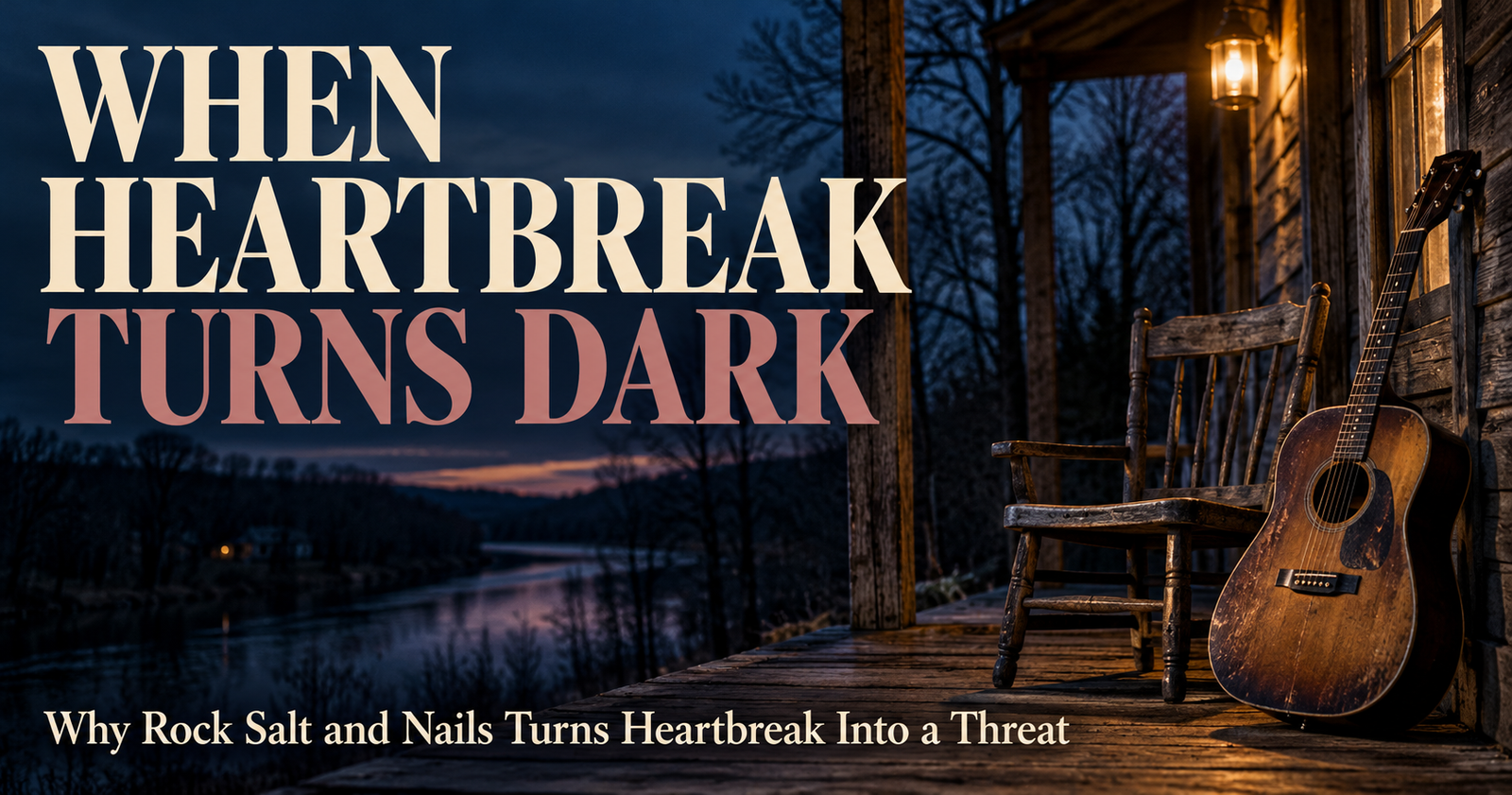
The man in “Rock Salt and Nails” misses a woman, believes she lied to him, and can’t stop turning the relationship over in his head. Then he imagines women as animals he could hunt and names what he’d load into a shotgun.
Well, that changes the conversation.
I read the song as heartbreak curdling into revenge. But the detail that makes it worth a closer look comes from Utah Phillips, who wrote it. He eventually wanted nothing to do with singing those feelings back into the room.
He Misses Her and Wants Her to Hurt
There’s an unpleasant little contradiction at the center of this song. The narrator can still remember the woman affectionately, but he also wants her to carry the weight of what happened.
Those feelings can exist together. You can miss somebody and be furious with them. Sometimes the missing is exactly what keeps the anger going.

What I find convincing here is that he hasn’t neatly sorted her into someone he hates. The affectionate memory is still there, getting in the way of his attempt to dismiss her.
If he could decide she meant nothing, he might have an easier night.
Instead, he’s stuck with a person he wants to blame and a face he doesn’t want to forget. That’s a much messier place to be than simply declaring a relationship over.
The Biggest Claim He Makes Is About Her Conscience
He’s certain she feels guilty. That’s the detail I’d underline.
We know he remembers her because he’s telling us. What we don’t get is any independent reason to know she’s lying awake thinking about him.
Maybe she is. Maybe she knows exactly what she did.
But I can also read his certainty as a small piece of comfort he’s hanging on to. If she feels guilty, he still matters. She hasn’t walked away from the relationship without taking something unpleasant with her.
That would make the pain feel a little less one-sided.
To me, that’s more revealing than the accusation that she lied. He wants to believe the breakup follows her around, too.
The song leaves her offstage, so we can’t settle it. We’re left with a man who speaks confidently about her feelings while struggling badly with his own.
Even the Riverbank Has Become Evidence Against Her
The opening puts us beside a river, with birds and cold water. It could have been a nice place to remember somebody.
He remembers being lied to there.
I don’t think the trees and birds need an elaborate explanation. The important thing is what he’s done with the memory.
Once you believe someone deceived you, it’s easy to start going back through everything. A sentence that seemed harmless becomes suspicious. A good afternoon becomes the afternoon you should have figured it out.
You’re practically cross-examining your own past.
That’s how I read this scene. He can still picture the place, but he can’t enjoy the memory without dragging the accusation into it.
The relationship has ended. The argument is still going on in his head.
Then He Brings a Shotgun Into It
The title isn’t a pretty metaphor that needs decoding. In the final image, rock salt and nails are what the narrator imagines putting in his shotgun.
His comparison turns women into creatures he could hunt.
That’s an ugly thought, and I don’t see much value in dressing it up. The song has moved from remembering an injury to imagining inflicting one.
Still, it doesn’t describe him actually shooting anybody. The situation is hypothetical. Calling it a murder story would add an event that isn’t there.
I’d call it a revenge fantasy.
The change from one woman to women generally matters, too. His grievance has grown beyond the person he believes wronged him. By the end, he’s taking the hurt of one relationship and pointing it outward.
That’s what makes the last image feel so bitter. He hasn’t found an explanation that helps him. He’s found something cruel enough to express how he feels.
Why Would Utah Phillips Refuse to Sing His Own Song?
This is where the background earns its place.
In a 2004 interview archived by the University of Utah, Phillips recalled singing “Rock Salt and Nails” once in Rosalie Sorrels’ living room. She recorded it, and he credited her with saving the song from being lost.
He also explained his refusal to keep singing it. He called it an “angry, mean love song,” said he no longer felt that way, and didn’t want to be unkind to the woman, who was still alive.
I find that much more interesting than the usual story of a songwriter proudly explaining how a favorite song came together.
Phillips was willing to put some distance between himself and something he’d written. The song survived, but he didn’t want to keep renewing the grievance.
There’s a difference between admitting you once felt something and deciding that feeling deserves another public performance.
His explanation doesn’t tell us every detail of the relationship. It does tell us he had reconsidered what it meant to keep singing about her that way.
That gives the story an unexpected second ending, outside the song itself.
Was It About Something That Really Happened?
Phillips’ remarks support a connection to a real woman and real feelings. They don’t verify every accusation in the song.
I’d be comfortable calling it personally rooted. I wouldn’t turn it into a factual account of a breakup we can reconstruct from beginning to end.
We don’t have her version.
That missing perspective is worth remembering, especially with a song this angry. A person can describe their pain accurately while still giving an incomplete account of how they got there.
I’m interested in what the narrator reveals about himself. There’s plenty to work with before we start inventing facts about the woman.
Tyler Childers Is Singing Someone Else’s Song
If you came to “Rock Salt and Nails” through Tyler Childers, the writing credit might be the piece you were missing.
The credits accompanying Childers’ official recording name Bruce “Utah” Phillips as the songwriter. The track appears on Live On Red Barn Radio II, released in 2014.
That matters because it’s easy to attach a song’s story to the person whose version you know.
Phillips’ comments explain his relationship with the song. They don’t make the narrator’s history part of Childers’ life, and they don’t tell us Childers’ reason for choosing it.
For me, knowing who wrote it adds something especially useful here. The narrator is caught in a feeling that seems to have no exit. Phillips lived long enough to look back and say he didn’t feel that way anymore.
The song never gives its angry man that moment. Its writer found one for himself.
Author: David Moss – David has helped song artists write lyrics all across the United States.
Comments
One response to “Why Rock Salt and Nails Turns Heartbreak Into a Threat”
[…] a similar discomfort in how Rock Salt and Nails lets us understand someone without accepting his whole account. Sympathy and trust don’t always travel […]